
On this page
- What are screens and reverse-curve guards?
- How do they compare?
- Which trees do they suit?
- How are they fitted?
- When should I choose micro-mesh instead?
- What about moss?
- How do the guard types handle Salem conditions?
- What to ask before buying a branded guard system
- When screens make sense
- Reverse-curve guards in detail
- Screens in detail
- What affects the price
- What affects the price
What are screens and reverse-curve guards?
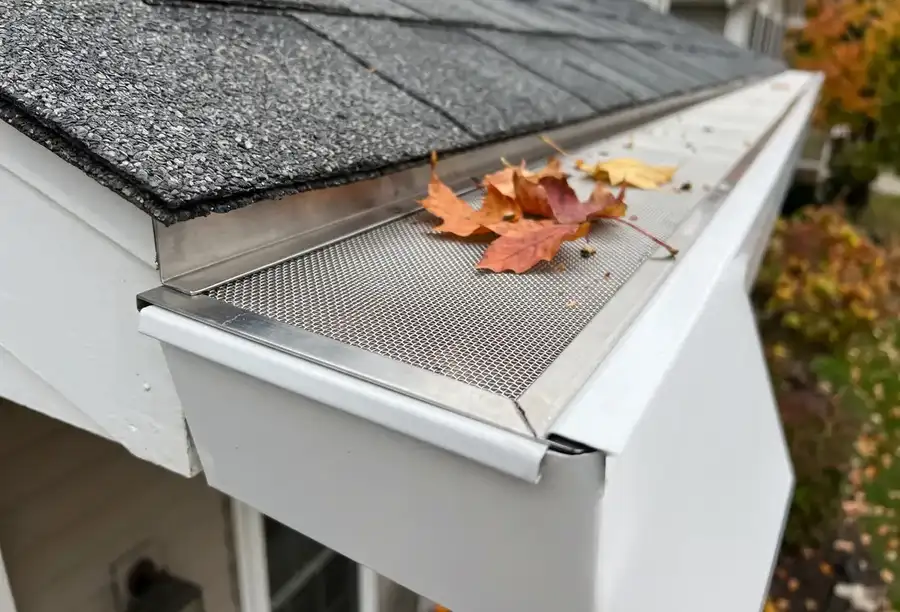
Screens are coarse covers laid over the gutter. Reverse-curve guards are solid hoods that rely on water clinging to a curved edge. Salem Hometown Gutters connects callers with independent local gutter contractors, who give the estimates and do the work.
How do they compare?
| Type | How it works | Suits | Problems |
|---|---|---|---|
| Plastic screen | Coarse mesh | Big leaves; low budget | Needles; breaks; lifts |
| Perforated aluminum | Sheet with holes | Leaves | Needles lodge; moss clogs |
| Reverse-curve hood | Water curls around the nose | Leaves on low-pitch roofs | Overflow in heavy rain; moss on the nose |
Which trees do they suit?
| Tree | Screen | Reverse-curve |
|---|---|---|
| Oregon white oak | Fair; acorns lodge | Good |
| Bigleaf maple | Good | Good |
| Douglas fir | Poor | Poor |
| Western redcedar | Poor | Poor |
How are they fitted?
- Clean the gutters.
- Check pitch and hangers.
- Lay or fix sections: screens snapped or screwed, hoods under the shingles or onto the fascia.
- Seal corners.
- Test.
When should I choose micro-mesh instead?
Under firs and cedars, on two-story houses where cleaning is a big job, and where ice storms could lift clipped-on screens. See micro-mesh gutter guards.
What about moss?
Shaded roofs in Salem grow moss, and moss sheds onto guards. Perforated covers and hood noses hold it. Plan to brush guards off at least once a year on shaded sides.
How do the guard types handle Salem conditions?
| Condition | Screen | Reverse-curve | Micro-mesh |
|---|---|---|---|
| Heavy oak leaf drop | Fair | Good | Good |
| Acorns | Lodge in holes | Slide off | Stay on top |
| Fir needles | Poor | Poor | Good |
| Moss on shaded runs | Holds it | Grows on the nose | Sits on top |
| Ice storm | May break | May dent | Best if screwed |
| Heavy rain | Good intake | May overshoot | Good intake |
What to ask before buying a branded guard system
- Which trees does it handle? Ask specifically about firs.
- How is it fixed? Screws, clips or under the shingles.
- What does the warranty cover? Clogging, the product, or both.
- Does the warranty transfer with the house?
- Who services it? And at what cost.
- What is the CCB number of the installer?
When screens make sense
A one-story house under maples, with no conifers nearby and a modest budget, can do well with a screwed-down aluminum screen. Cheap plastic screens that clip in rarely last a Salem winter.
Reverse-curve guards in detail
A reverse-curve or "surface tension" guard is a solid cover that rolls over the front of the gutter. Water follows the curve and drops through a slot into the gutter; leaves are meant to slide off. They work best on lower-pitch roofs and with broad leaves. On steep roofs, in heavy rain or at valleys, water can shoot past the nose. Fir needles and moss tend to collect in the slot.
Screens in detail
| Screen type | Notes |
|---|---|
| Snap-in plastic | Cheap; brittle in cold; lifts in wind |
| Expanded aluminum | Stiffer; holes large enough for needles |
| Perforated aluminum | Better; holes clog with grit and moss |
| Hinged screens | Flip up for cleaning |
What affects the price
| Factor | Effect |
|---|---|
| Product | Screens lowest; branded hoods highest |
| Feet and stories | Base and access |
| Corners and valleys | Fitting time |
| Gutter repairs first | Extra |
What affects the price
Screens are the cheapest guards; reverse-curve systems cost more and are often sold as branded systems with warranties. Ask what the warranty covers and whether it transfers with the house.